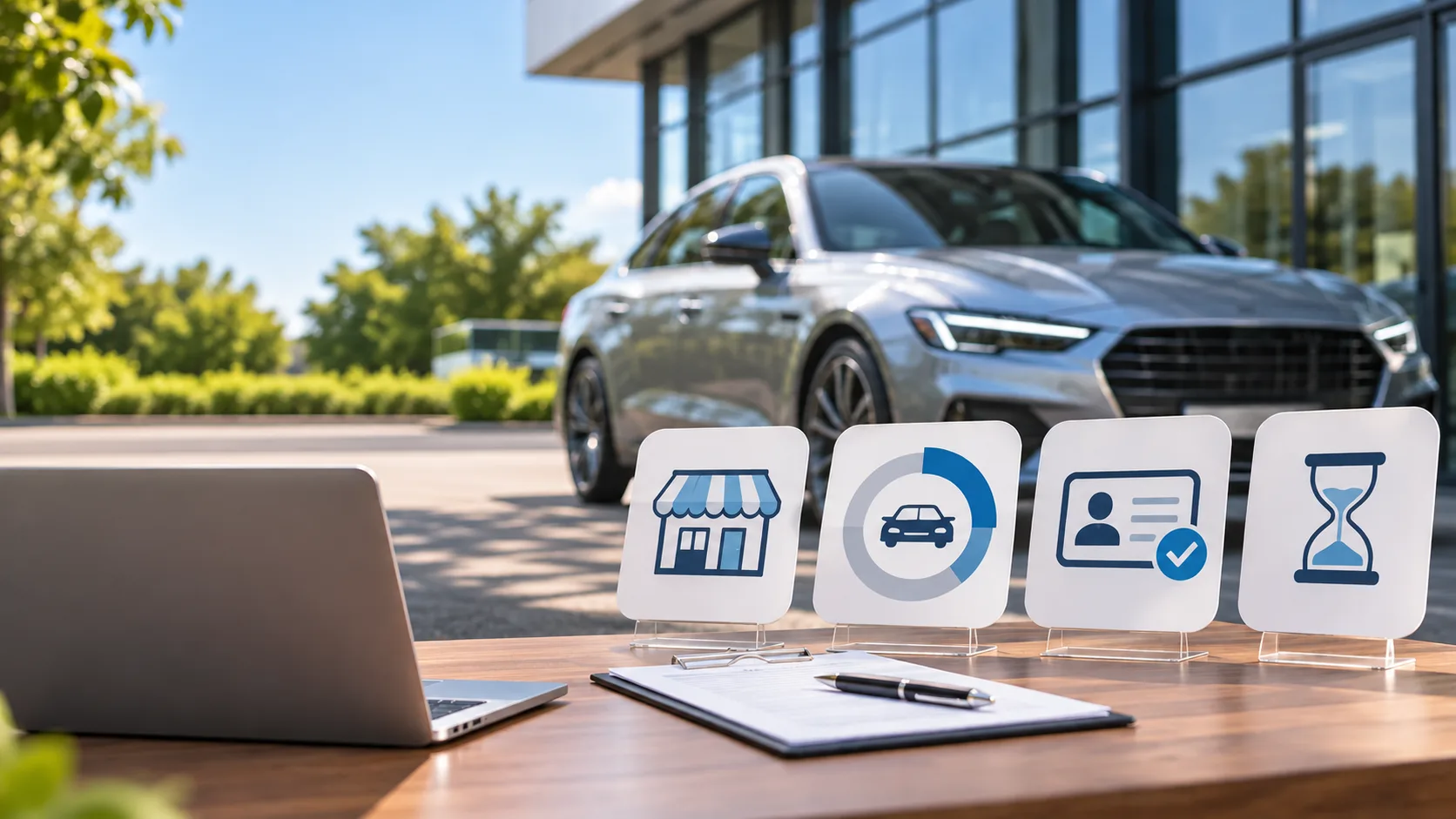








Leasing and a loan get you to the same place, but they affect your balance sheet, your VAT and your borrowing capacity in completely different ways. We compare both on real numbers and show when each one wins.
Leasing and a car loan take you to the same destination — a car parked outside the company, working. They differ in everything that happens along the way: who owns the vehicle, how you account for VAT, what a bank sees on your next application, and what you actually pay.
Ownership: the fundamental difference
With a loan you own the vehicle from day one. The car enters your fixed asset register and you depreciate it. The bank secures itself with a pledge or an assignment from the insurance policy, but ownership is yours.
In an operating lease the lessor remains the owner for the whole term. You use the vehicle and pay instalments, and ownership passes only on buy-out — if you decide to take it.
That difference drives everything else.
Tax treatment
In an operating lease the whole instalment is a cost, subject to the proportion arising from the vehicle value cap. For a combustion car the cap is 100 000 zł, for a plug-in hybrid below 50 g/km CO2 — 150 000 zł, for an electric car — 225 000 zł.
With a loan, the deductible items are the interest and the depreciation write-offs. Depreciation is subject to an equivalent cap, and the standard rate for a passenger car is 20% a year, which means five years of write-offs.
The practical consequence is that an operating lease over 36 or 48 months lets you write off the value of the car faster than five-year depreciation under a loan.
VAT
This is where the difference matters most for cash flow.
- Operating lease. VAT is charged on each instalment and you reclaim it as you go — 50% for mixed use, 100% where the vehicle is used exclusively in the business.
- Loan. VAT on the full value of the vehicle is paid up front at purchase. You reclaim it in one go, but you have to find it first.
On a car at 160 000 zł net, VAT is close to 37 000 zł. In a lease that sum is spread across the whole term.
Borrowing capacity and the balance sheet
An operating lease does not increase balance sheet debt to the same extent as a loan — the instalment is an operating cost. For a company planning an investment or mortgage loan in the next few years, that can be the deciding argument.
Leasing also appears in credit records in a different form from a loan obligation, though that does not make it invisible.
Paperwork and time
Leasing wins almost every time. The simplified procedure can produce a decision in one or two days on the basis of an ID card and a tax number alone. A business loan usually requires full financial documentation, certificates and a valuation of the security.
For businesses with a short trading history the difference is starker still: the lessor secures itself with the vehicle, so it accepts risk a bank refuses.
A loan is better in one specific situation: when you plan to keep the car a long time, six years or more. The five-year depreciation completes, and you stop paying the cost of financing for the period when the car is already yours.
Making the decision
Choose leasing if you care about liquidity, a fast decision, changing the car every three to four years and spreading VAT over time. Choose a loan if you want ownership from the start, plan to run the vehicle for many years, and have the cash for the VAT.
Frequently asked questions
Which is cheaper — leasing or a loan?
Over a three to four year horizon, usually leasing, mainly because VAT is spread out and the value of the car is written off faster. Over six years or more the loan starts to win, because once it is repaid you no longer carry any cost of financing.
Does leasing reduce a company's borrowing capacity?
It affects it, but less than a loan of the same value, because a lease instalment is an operating cost rather than balance sheet debt in the classic sense. Banks do count lease instalments when calculating commitments, so leasing is not invisible to them.
With a loan, do I reclaim all the VAT immediately?
You reclaim it in one go at purchase, but at a rate depending on use: 50% for mixed use, or 100% where the vehicle serves the business exclusively, after notifying the tax office and keeping a mileage log. The full VAT amount has to be funded first.
Share this article: